Arcov
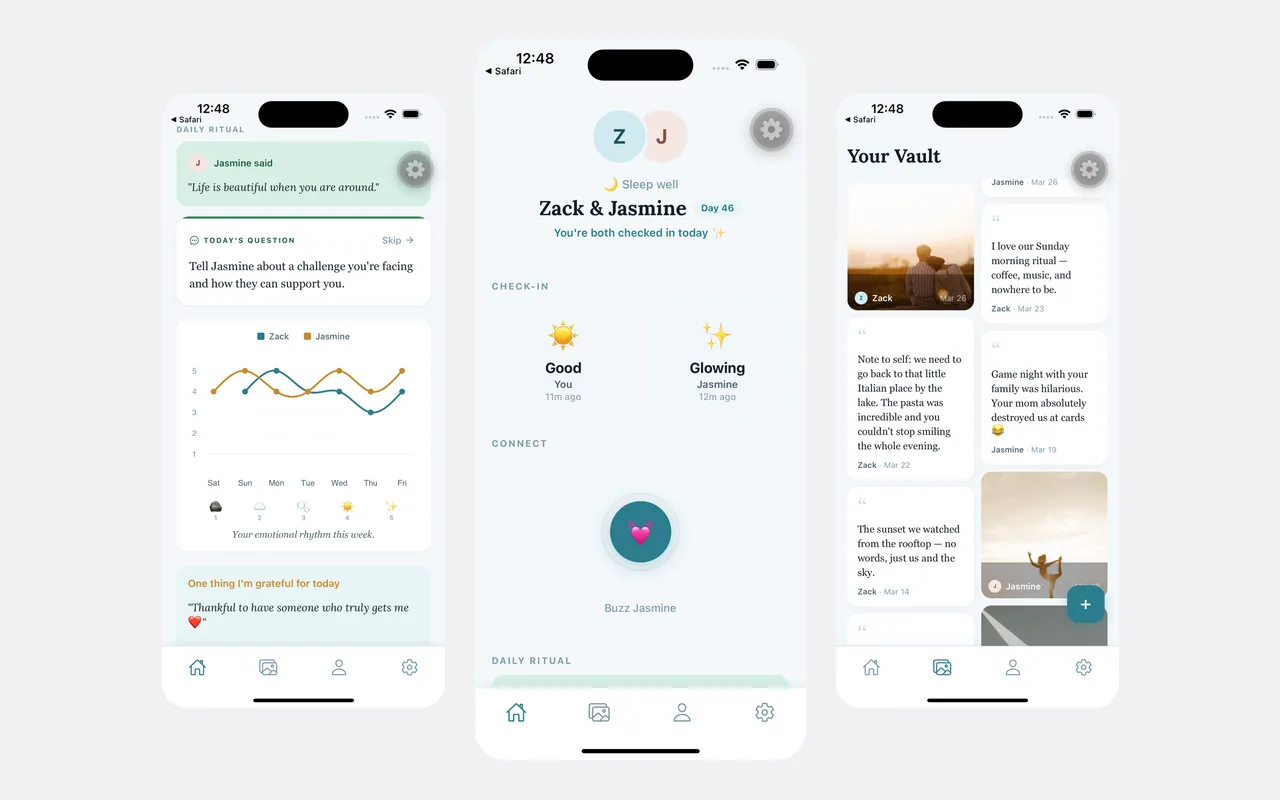
A private two-person app for couples, built especially for long-distance relationships and partners in different time zones. Each day, partners share a mood check-in, send a one-tap Buzz or a press-and-hold Hug, write each other one letter, and answer a shared question that stays hidden until both have replied. Photos, voice notes, and drawings live in an end-to-end encrypted vault. There is no feed and no followers: one partner per account.
Our own product · Mobile app, iOS and Android
- First commit to App Store
- About 3 months
- Platforms
- iOS and Android, one codebase
- Releases
- 1.0 (Jun 2026) to 1.1.1 (Oct 2026)
- Stack
- Expo, React Native, Supabase
The brief
Couples who live apart need a way to stay close that takes seconds, not a long call. That meant a fast daily check-in, notifications that arrive at the right time in the right time zone, widgets on the home screen, and somewhere private to keep shared photos and notes.
What we built
- One React Native and Expo codebase in TypeScript for iOS and Android, so both platforms ship the same features on the same day.
- Supabase for accounts, data, and storage, with the shared vault end-to-end encrypted so only the couple can read it.
- Native home-screen widgets on both platforms, wired into the shared app.
- Released to the App Store and Google Play, and maintained since through OS updates and store reviews.
- React Native
- Expo
- TypeScript
- Supabase
The hard parts
Encryption that cannot silently fail
The vault is encrypted on the device with XChaCha20-Poly1305 before anything is uploaded, so the server only ever stores ciphertext. If someone loses their phone, their partner can restore their access through a split key, with a 12-word phrase as the fallback. The hard part is not the cipher but the failure cases: a key that cannot be read after a reinstall, or a download that fails and looks like a decryption error. Every key failure is detected at launch and routed to one recovery screen, and a regression suite guards the crypto paths on every release.
Widgets that tell the truth on both platforms
Home-screen widgets are native code: Swift and WidgetKit on iOS, Kotlin on Android, fed by data the shared app writes. Widgets refresh while the app is closed, so a wrong state can sit on someone's home screen for hours. We built a harness that photographs every widget state on both platforms before release, which caught defects our unit tests missed, such as a label iOS truncated and Android rendered in full.
Shipping fixes without breaking older installs
JavaScript fixes ship as over-the-air updates, with the update's runtime version tied to the app version, so an update built for 1.1 can never reach a 1.0 install. Native changes go through a full store build, and every release has its own branch so hotfixes never pick up unfinished work.
Have a project like this?
Send a few lines below. We reply within one business day, set up a short call, and send a written estimate of cost and timeline within two business days of it. No charge, no obligation.
Or reach us directly
- info@tuwarcorp.com
- Phone
- +1 (437) 997-3667
- Studio
- Toronto, Ontario, Canada
We only use what you send here to reply to your enquiry. Read the privacy policy for the detail.